Spitzer's Dilemma: "Eliot Snoozer" 11-02-2006 |
Lawyer Practicing in New York Admits Advising That Death Threats Are Legal;Eliot Spitzer Snoozes According to bankruptcyMisconduct.com |
|
NEW YORK, Nov 02, 2006 /PRNewswire via COMTEX/ -- A lawyer admitted to practice in New York and Federal Courts conceded a transcript filed in court contained an accurate portrayal of a conversation in which the lawyer advised his client that it was perfectly fine to threaten to kill someone.
Eliot Spitzer was the elected Attorney General for the State of New York, with ultimate responsibility to enforce the law as well as to uphold the purported ethical standards for attorneys in New York State by following and supporting The Lawyer's Code of Professional Responsibility. Eliot Spitzer has managed an office which rattled the boardrooms of big business throughout the state as he delighted a skeptical citizenry with numerous assaults on corporate misdeeds. Countless industries have had their often secret business practices brought before the courts and thrust into the light of day; except of course, for perhaps the most secretive and lucrative "profession." Powerful law firms continue to operate above the law and beyond scrutiny. Sadly, Mr. Spitzer's talent for appearing as a zealous foe of corruption and wrongdoing ceases where brethren of the bar are concerned. Apparently Mr. Spitzer believes every business is bad except his own. Do voters want an Attorney General who protects his partners and associates while prosecuting only those unworthy of special protection? If elected, will Andrew Cuomo continue the Spitzer legacy of Law Firm Protectionism? What could voters expect from Mr. Spitzer as Governor? This release was authored by bankruptcyMisconduct.com and was not sponsored, advised, or funded by any candidate for office. Statements herein other than fact are opinion and readers are urged to become fully informed of the issues. Documents evidencing factual elements of this press release are public record at the U.S. Bankruptcy Court in Manhattan SDNY 02-13533 docket numbers 17315, 17315A copies available at http://www.bankruptcymisconduct.com. SOURCE bankruptcyMisconduct.com |
= = =
We received some comment from the media questioning the accuracy of the above press release. While we agree that it seems unbelievable, it is true and fully verifiable. Immediately below is an excerpt of the hearing in front of U.S. Bankruptcy judge Arthur J. Gonzalez during which the attorney admits that the transcript which was filed was accurate, in fact the attorney surmises that the conversation was recorded. click here for a view of the hearing transcript from the Worldcom / MCI bankruptcy case. 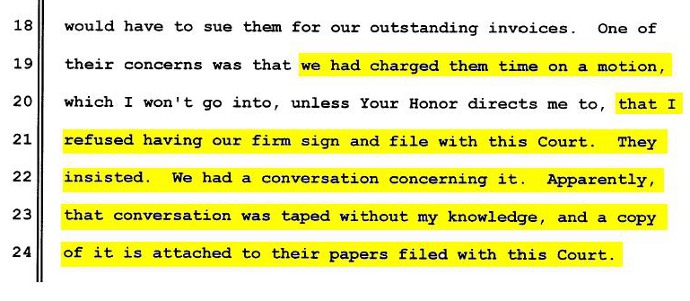
Emphasizing the candor of the conversation, while admitting that the transcript of the conversation was accurate, the lawyer and the federal judge surmise that the conversation was "apparantly" recorded. The original motion was filed as docket number 17315 which you can get here, and docket number 17315A has the exhibits which you can get here. If you want only the conversation transcript (which was not originally made during an official proceeding but was conceded as accurate by the lawyer as it appeared at exhibit C to the motion) then you can get it here. Following is a highlighted excerpt. The attorney's remarks certainly warrant at a minimum the mandated referral under Title 18 U.S.C. § 3057 by the U.S. Trustee (a DOJ employee) and the federal judge. An unresolved issue is whether the "I" underlined below in red was a reference by the attorney to another party who would be hired to perform a murder, or if the attorney was conveying that other parties are threatening a murder. Of prime significance is that the lawyer introduced the topic of death threats a propos during a discussion in which the lawyer attempted to thwart Next Factors' instigation of an examination of conflict of interest issues related to the bankruptcy professionals in the Worldcom case and corresponding disparity of treatment in the timing or amount of recoveries to hedge funds and their claims trading affiliates. As in all bankruptcy cases, Worldcom professionals were required to disclose any prior or simultaneous hiring by creditors such as hedge funds, and their claims trading affiliates, in all other matters; as such would pose a conflict with their duty to be adverse to the same creditors in the Worldcom case. Regarding any disparity in treatment among creditors, the fundamental purpose of the Federal Bankruptcy Code (Title 11 U.S.C.) is that each creditor of the same class receives the same recovery (See Marcia's Petard here). We believe that any preliminary analysis of the alleged death threat must first determine whether motive could be inferred by the actual existence of either undisclosed conflicts or disparity in treatment. As to the admittedly radical notion of whether a professional could commit a crime in the course of their employment, perhaps coincidentally we see that one of the professional firms in the Worldcom bankruptcy (receiving over $130 Million in fees) has admitted conspiracy to commit fraud in the largest fraud case ever brought by the DOJ (unrelated to Worldcom). Further, The New York Times reported here multiple assertions by a DOJ employee, and a finding by a federal judge, of a failure to perform mandatory disclosure of a conflict of interest in another bankruptcy case; such misconduct was committed, perhaps coincidentally, by the same law firm which billed fees as lead attorney in the Worldcom bankruptcy case. 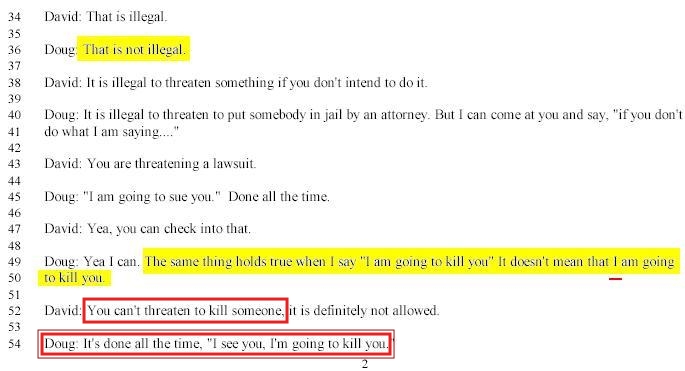


- Apollo Global Management
- eToys & Mukasey
- Kelly's Smelly WebSci
- Jones Day Swallows Slop
- Eliot Spitzer
- To Rat, or Not To Rat
- Why Hire These Lawyers?
- Dewey LeBoeuf Questions
- O'Brien's Dilemma
- Marcia Goldstein
- Tashina Guahar
- Innocent's Imperative
- Quid Pro Quo
- Uhland Walking
- Pillsbury Winthrop
- Judge: Hide This
- Bankruptcy Pimp
- Gibson Dunn & Crutcher
- "Books & Records" Fraud
- Citibank "in Play"